
Hosea 9
When Sin Finally Bears Its Fruit

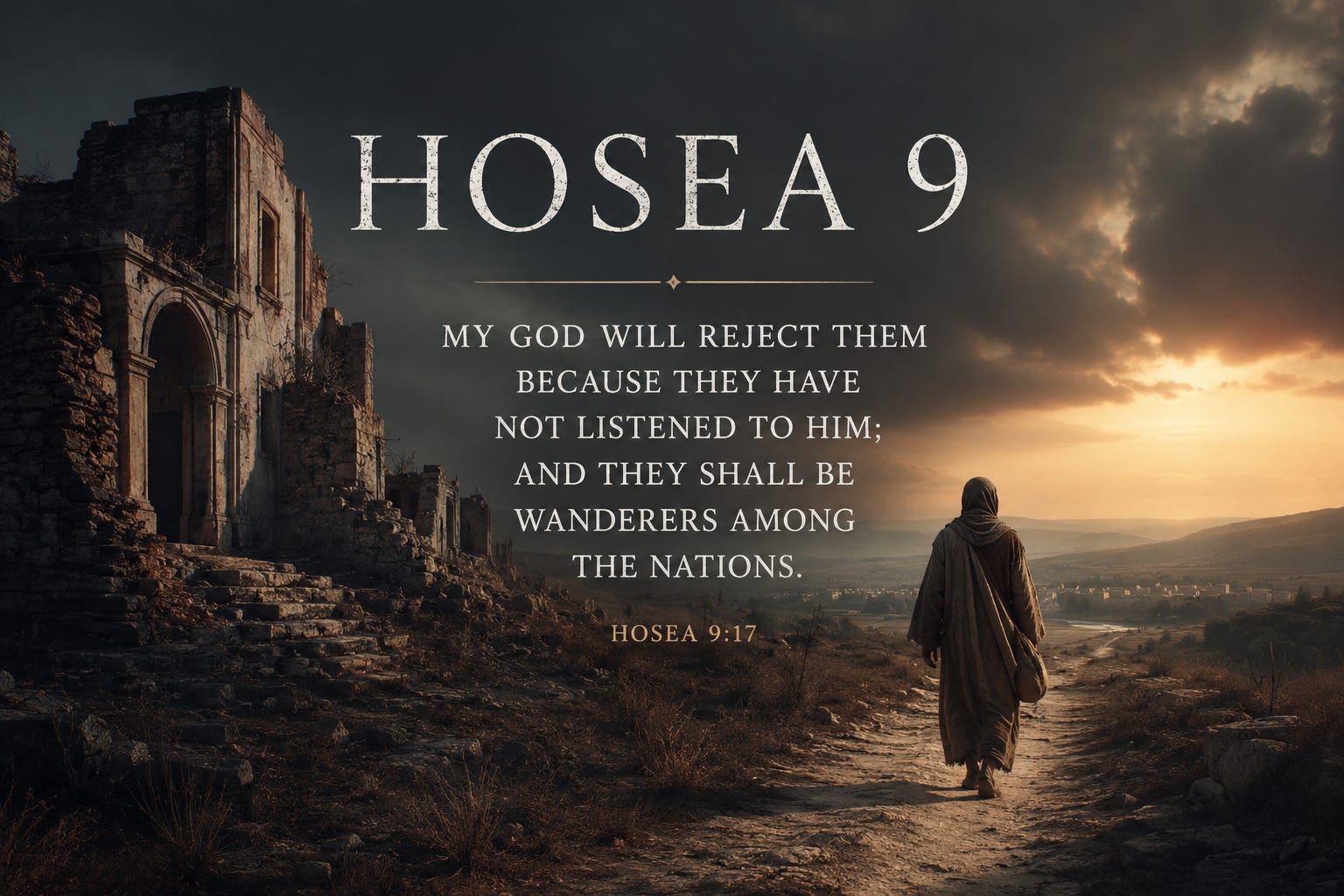
“Do not be glad, O Israel, with rejoicing like the peoples! For you have played the harlot, forsaking your God. You have loved harlots’ earnings on every threshing floor. Threshing floor and wine press will not feed them, And the new wine will deceive them. They will not remain in the land of Yahweh, But Ephraim will return to Egypt, And in Assyria they will eat unclean food. They will not pour out drink offerings of wine to Yahweh; Their sacrifices will not please Him. Their bread will be like mourners’ bread; All who eat of it will be defiled, For their bread will be for themselves alone; It will not enter the house of Yahweh. What will you do on the day of the appointed festival And on the day of the feast of Yahweh? For behold, they will go because of destruction; Egypt will gather them up; Memphis will bury them. Weeds will possess their desirable items of silver; Thorns will be in their tents. ¶The days of punishment have come; The days of recompense have come; Let Israel know this! The prophet is an ignorant fool, The inspired man has madness, Because of the abundance of your iniquity And because your hostility has abounded. Ephraim was a watchman with my God, a prophet; Yet the snare of a bird catcher is in all his ways, And there is only hostility in the house of his God. They have dug deep in corruption As in the days of Gibeah; He will remember their iniquity; He will punish their sins. ¶I found Israel like grapes in the wilderness; I saw your fathers as the earliest fruit on the fig tree in its first season. But they came to Baal-peor and devoted themselves to shame, And they became as detestable as that which they loved. As for Ephraim, their glory will fly away like a bird— No birth, no pregnancy, and no conception! Though they bring up their children, Yet I will bereave them until not a man is left. Surely, woe to them indeed when I depart from them! Ephraim, as I have seen, Is planted in a pasture like Tyre; But Ephraim will bring out his children for killing. Give them, O Yahweh—what will You give? Give them a miscarrying womb and dry breasts. ¶All their evil is at Gilgal; Indeed, I came to hate them there! Because of the evil of their deeds I will drive them out of My house! I will love them no more; All their princes are rebels. Ephraim is stricken; their root is dried up; They will bear no fruit. Even though they bear children, I will put to death the desirable ones of their womb. My God will despise them Because they have not listened to Him; And they will be those who flee among the nations.” Hosea 9:1-17
There is a dangerous assumption that has plagued God’s people in every generation: if life appears to be flourishing, then God must be pleased.
Israel believed that lie. They still do today.
“Do not rejoice, O Israel, with joy like other peoples, for you have played the harlot against your God…”
A command against rejoicing.
Israel thought their celebrations were signs of blessing. Their festivals continued, their economy functioned, and their worship appeared active. But God declares that their joy is corrupted.
The language of played the harlot is covenant language. Israel is purposely and willingly breaking the relationship. The grief here is personal.
What Israel calls celebration, God calls unfaithfulness.
“The threshing floor and the winepress shall not feed them, and the new wine shall fail in her.”
The threshing floor and winepress represent provision, harvest, and stability. Israel believed these were guaranteed.
But God removes the very places Israel had come to associate with prosperity.
The threshing floor and winepress were the center of Israel’s agricultural life. These were the places where grain was separated and wine was produced, the visible proof of whether the year would end in abundance or famine. In Canaanite culture, and increasingly in Israel’s compromised worship, these spaces were also entangled with Baal ideology. They believed that fertility of the land was secured through the favor of local deities tied to nature and harvest cycles.
What they trusted as the source of stability will fail them. What they assumed was secured by ritual and seasonal cycles will dry up.
“They shall not remain in the LORD’s land, but Ephraim shall return to Egypt, and shall eat unclean food in Assyria.”
The land was an inheritance under covenant. To remain in the land meant to remain under blessing. To be removed meant covenant displacement.
“Return to Egypt” is not just literal repetition but it is also symbolic regression. They are going back to what God already delivered them from.
Assyria becomes the new Egypt.
Sin always moves people backward, never forward.
“They shall not pour drink offerings of wine to the LORD, and their sacrifices shall not please Him…”
Worship itself becomes unacceptable.
The sacrificial system remains unchanged in form, but it is now void of covenant reality because the heart that once gave it meaning has departed from the Lord.
God says their offerings will be like “bread of mourners,” something ceremonially unclean.
Religious activity continues, but the relational reality it once expressed is gone. Showing that it is entirely possible to persist in religious practice while being cut off from the living fellowship of God.
“What will you do on the day of appointed festival, and on the day of the LORD’s feast?”
God is asking a rhetorical question.
When judgment arrives, what will they do with their festivals?
Their religious calendar cannot protect them from the consequence. There will come a moment when routine worship cannot hold up under reality.
“For behold, they are going away from destruction; Egypt shall gather them up; Memphis shall bury them…”
Egypt here functions as the symbol of return to bondage. What God once delivered them from becomes the image of where they are headed again. Assyria stands behind the historical horizon as the instrument of this reversal, but Egypt captures the theological meaning: a return to slavery under judgment.
Memphis, a major burial center of ancient Egypt, marks the final stage of the image. The journey does not end in relocation or displacement, but in death. What started as unfaithfulness now reaches its full expression in the collapse of national life.
“The days of punishment have come; the days of recompense have come; Israel shall know it.”
The repetition is intentional, it has arrived.
Israel spent generations being warned. Now they will experience what they ignored.
And then the verse turns personal…
“The prophet is a fool, the man of the spirit is mad…”
Those who speak God’s word are dismissed as irrational, while those who reject it are treated as reasonable and balanced. This is not only Hosea’s world. It is a recurring pattern in every age where truth confronts rebellion.
Before judgment is ever seen in outward collapse, it is first found in distorted perception, where the clarity of God’s word is rebranded as foolishness in the ears of those who no longer want to hear it.
“The watchman of Ephraim was with my God; but a fowler’s snare is in all his ways…”
A watchman is meant to protect. But here even the watchman is surrounded by traps.
Israel’s spiritual leadership is compromised. The very ones meant to warn the people are entangled in the same deception.
“They are deeply corrupted as in the days of Gibeah…”
Gibeah (Judges 19) represents one of the darkest moral failures in Israel’s history.
Hosea is saying that they have not progressed beyond their worst moments, they have returned to them.
Sin is not neutral. It does not stay contained. It regresses and intensifies over time.
“I found Israel like grapes in the wilderness…”
God shifts to memory.
He describes Israel’s beginning as something rare and precious, grapes in a barren place.
I’ve found muscadines in the woods before, parched and worn, and the sweetness of them felt like a kind of mercy.
There is affection in this verse. Israel was once desired, chosen, and set apart.
But memory quickly turns to sorrow.
“…but they came to Baal Peor and consecrated themselves to shame…”
The turning point is Baal Peor (Numbers 25).
Israel’s history of intimacy with God is interrupted by idolatry and immorality.
From being set apart by God to being set apart for shame. That is always the trajectory of unfaithfulness: from glory to distortion.
“Ephraim’s glory shall fly away like a bird…”
What was once stable is now described as flight and sudden loss.
Then it becomes worse.
“No birth, no pregnancy, no conception…”
This is reversal imagery. Fruitfulness was a sign of blessing; now even future generations are cut off. Sin does not only affect the present, it unapologetically disrupts the future.
“Ephraim, as I have seen, was like a young palm planted in a meadow…”
So we see that God remembers what Israel looked like when planted with promise.
But the image collapses.
“…but Ephraim must lead out his children to slaughter.”
This is one of the most difficult lines in Hosea. It shows the generational reach of judgment. It shows how sin is like a disease that is spread from one generation to the next.
Then the prophet responds.
“Give them, O LORD—what will You give? Give them a miscarrying womb and dry breasts.”
Some may view this as cruelty. It is not. It is prophetic grief.
Hosea is overwhelmed. He is not detached from judgment instead he is caught inside its weight of it.
He is asking, in essence, what mercy even looks like at this point.
“All their evil is in Gilgal; there I began to hate them…”
Gilgal was once a place of covenant renewal (Joshua 4–5).
But now it has become the center of rebellion, and they have defiled the sacred places God once provided for them.
Then God declares judgment.
“…I will drive them out of My house; I will love them no more.”
What was once given as life becomes the very ground of their removal.
“Ephraim is stricken, their root is dried up; they shall bear no fruit…”
This is the root image again. Everything outward collapses because the root is dead.
It is the final stage of long-term spiritual decay. Fruitlessness becomes the evidence of Israel’s decay.
Here Hosea is speaking again, not quoting God directly, but reflecting on what has been declared. The tone shifts from divine speech to a prophetic conclusion.
And the outcome is wandering.
Israel is left displaced. Not only in geography, but in spirit and belonging.
Hosea 9 is written to show what judgment looks like when relational rejection runs its full course.
There is no soft landing in this chapter.
Joy collapses. Worship is cut off. Leadership fails. Memory becomes grief. And future generations are affected by present rebellion.
But Hosea is not the end of the story.
The same covenant God who speaks this judgment is the One who later says:
“How can I give you up, Ephraim?”
And in Christ, that conflict is finally resolved.
Where Israel became fruitless, Christ becomes the true vine.
Where Israel is driven out, Christ is driven outside the city.
Where Israel is rejected, Christ is the rejected One.
And where Israel is wandering, Christ comes as the Shepherd who seeks and saves.
Hosea 9 shows what sin produces when left to itself.
The Gospel shows what God does when He refuses to leave sinners in it.
Because He is a merciful loving God.
https://ganiruofalltrades.substack.com/p/s3xual-sin-is-not-bad?r=78uziu&utm_campaign=post&utm_medium=web&showWelcomeOnShare=true
But is it that bad?
Tyler, thanks for sharing this with me. Wow, what a excellent and theologically saturated piece. I really appreciate how you expounded the Hosea 9 passage. Your words are rooted in Scripture, and pointing out so much of Israel’s unfaithfulness made your final thoughts about Christ being all that Israel could not be, stand out in radiant contrast. Thank you for being faithful to Scripture. Thank you for getting to Jesus, who was driven out and rejected so we wouldn’t be, who is the true vine, and the Shepherd when we wonder.