
Hosea 6: Return, Know, and Live!

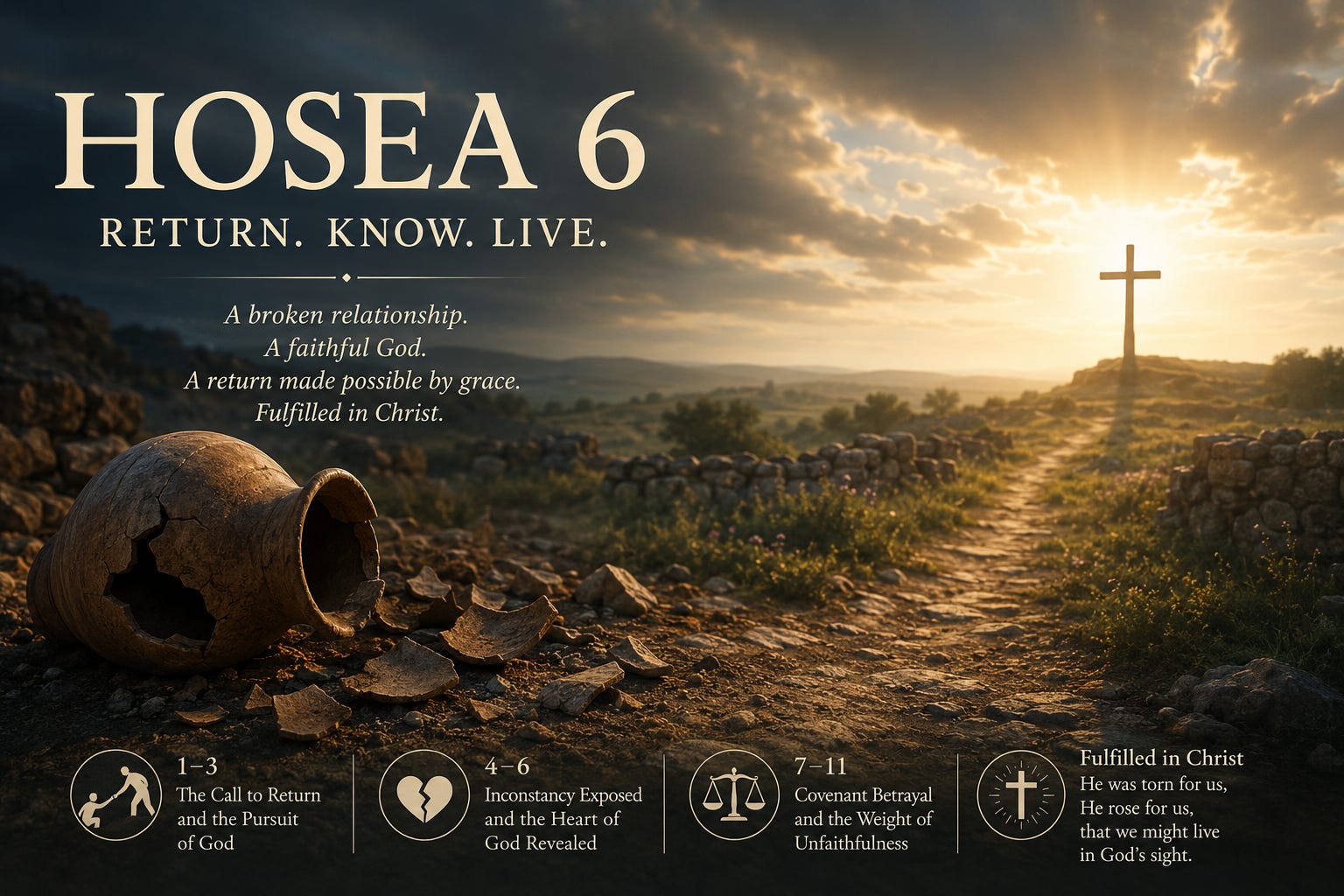
“Come, and let us return to the Lord; For He has torn, but He will heal us; He has stricken, but He will bind us up. After two days He will revive us; On the third day He will raise us up, That we may live in His sight. Let us know, Let us pursue the knowledge of the Lord. His going forth is established as the morning; He will come to us like the rain, Like the latter and former rain to the earth. “O Ephraim, what shall I do to you? O Judah, what shall I do to you? For your faithfulness is like a morning cloud, And like the early dew it goes away. Therefore I have hewn them by the prophets, I have slain them by the words of My mouth; And your judgments are like light that goes forth. For I desire mercy and not sacrifice, And the knowledge of God more than burnt offerings. “But like men they transgressed the covenant; There they dealt treacherously with Me. Gilead is a city of evildoers And defiled with blood. As bands of robbers lie in wait for a man, So the company of priests murder on the way to Shechem; Surely they commit lewdness. I have seen a horrible thing in the house of Israel: There is the harlotry of Ephraim; Israel is defiled. Also, O Judah, a harvest is appointed for you, When I return the captives of My people.” Hosea 6:1-11
The Call to Return and the Hope of Restoration
When we approach Hosea 6:1–2, we should first read it as historical truth before reading it devotionally or prophetically.
The prophet ministered during a spiritually corrupt period in the northern kingdom of Israel. Idolatry had become normal. Priests were corrupt. Justice was distorted. Worship had become performative rather than relational. Israel still carried the language of covenant while living in practical unfaithfulness. Hosea’s ministry exposes this contradiction repeatedly.
So when the text says:
“Come, and let us return to the Lord;
For He has torn, but He will heal us;
He has stricken, but He will bind us up.”
The language is deeply relational.
Yet we must be careful in how we frame that brokenness. God did not sin against Israel. God did not betray the covenant. The relationship was torn by the people themselves.
Israel wandered. Israel pursued idols. Israel hardened itself against the Lord. The tearing described in Hosea is the righteous discipline of God responding to covenant rebellion.
Like a loving father disciplining a son, God wounds in order to restore.
This is one of the great tensions throughout Scripture… The holiness of God refuses to ignore sin, yet the mercy of God refuses to abandon His people entirely.
And so, that is why the passage begins with an invitation:
“Come, and let us return to the Lord.”
The covenant relationship was not transactional at its core. God was not seeking empty religious performance. He desired communion, faithfulness, knowledge, and love.
Israel’s problem was not disobedience to rules. Their hearts had drifted from the Lord Himself. Their worship continued outwardly while intimacy with God disappeared inwardly.
In that sense, Hosea is profoundly personal.
The covenant involved nations, kings, priests, and public worship, but it always carried relational implications between God and His people. The Lord was not calling Israel back to ceremony. He was calling them back to Himself.
Israel recognizes that the same God who judged them is also their only hope of healing. The One offended by their sin is still the One capable of restoring them.
And then comes the mysterious language:
“After two days He will revive us;
On the third day He will raise us up,
That we may live in His sight.”
Historically, the immediate meaning points toward restoration after judgment. “Two days” and “third day” likely communicate the idea of a short but decisive period before renewal comes. In Hebrew poetry, numbers are often symbolic and literary rather than strictly chronological.
Many Jewish readers throughout history have understood this passage primarily as a declaration of national restoration and covenant renewal.
Yet Christians have long noticed that the language reaches beyond Israel’s immediate circumstance in remarkable ways.
The imagery of revival, raising up, and life before God carries resurrection overtones that echo throughout Scripture. Because of this, many theologians understand Hosea 6 not necessarily as a direct messianic prediction, but as a prophetic pattern ultimately fulfilled in Christ.
The prophet may not have consciously been declaring, “The Messiah will literally rise from the grave on the third day.” Yet under divine inspiration, the text participates in a broader biblical theme that finds its culmination in Jesus Christ.
Throughout Scripture, the “third day” becomes associated with deliverance, revelation, and life emerging from apparent death. The pattern appears repeatedly until it reaches its fullest expression in the resurrection of Christ.
This is why many Christians see Hosea 6 as typological rather than merely predictive.
Israel longed to be revived.
Christ became the resurrected One.
Israel sought restoration after judgment.
Christ bore judgment Himself and conquered death.
Israel desired to live in God’s sight again.
Through Christ, reconciliation with God becomes fully realized.
And perhaps most beautifully, Jesus embodies the faithful covenant partner Israel failed to be.
Hosea repeatedly reveals the instability of human devotion. Israel’s faithfulness fades “like the morning cloud.” Their repentance often proves shallow and temporary. The problem is the inconsistency of the human heart.
That truth extends beyond ancient Israel. Humanity continually damages its relationship with God through pride, sin, self-rule, and spiritual adultery. Yet the glory of the gospel is that God does not abandon covenant entirely.
Instead, He fulfills what humanity could not.
So when Christians read Hosea 6, they often see both historical reality and redemptive foreshadowing intertwined together. The passage stands firmly in Israel’s historical experience while simultaneously pointing beyond itself toward the greater healing, revival, and reconciliation accomplished through Christ.
The torn relationship between God and man is not ultimately healed through sacrifice alone, but through the faithful love of God pursuing sinners all the way to resurrection.
The Pursuit of God and the Faithfulness of His Presence
“Let us know, let us pursue the knowledge of the Lord…”
The language shifts from restoration as an event to restoration as a pursuit. This is important in Hosea’s theology. The problem was never merely that Israel needed relief from consequences; it was that they had lost knowledge of God Himself.
In covenant terms, this is relational language. “Knowledge” here is intimate, experiential, and covenantal. Which is what it means to live in fellowship with the Lord rather than merely acknowledge Him externally.
So the call is not just, “Let us return,” but, “Let us know Him again.”
And then the text grounds that pursuit in God’s own character.
“His going forth is established as the morning…”
Israel’s faithfulness has already been described as unstable and fading like morning dew earlier in the chapter.
Now God’s character is placed in direct contrast: His “going forth” is not sporadic, emotional, or inconsistent, instead it is as fixed as the sunrise itself. In other words, the instability in the relationship has not come from God’s unreliability, but from Israel’s.
“He will come to us like the rain, like the latter and former rain to the earth.”
In an agrarian world, rain is life. The “latter and former rain” marked the beginning and end of the agricultural cycle. Together, they represented completeness, provision, and sustained faithfulness. The point is not just that God visits His people, but that He sustains them.
Yet even here, Hosea is not naive about Israel’s condition. The poetry expresses what should be true in covenant return, while the surrounding context of the chapter will soon reveal what is actually true in Israel’s repentance. Their words are sincere in tone but shallow in endurance.
God’s character is not in question. The human heart is.
And this keeps the entire passage anchored in the fact that this covenant is fundamentally relational. But in Hosea, the tragedy is not that God withdrew from the relationship, it is that the relationship was repeatedly fractured by unfaithfulness on Israel’s side.
This sets up the tension that the rest of the chapter will expose: a people who can speak the language of return, while still lacking the enduring knowledge of the God they claim to pursue.
Relational Inconstancy and the Heart of God
“O Ephraim, what shall I do to you? O Judah, what shall I do to you? For your faithfulness is like a morning cloud, and like the early dew it goes away.”
The language here is deeply relational. God speaks as one in an ongoing covenant relationship that has been repeatedly strained. The question “What shall I do with you?” is not confusion in God, it is grief. It reveals the tension of persistent mercy meeting persistent inconsistency.
Israel’s problem is not lack of words. As verses 1–3 showed, they know how to speak the language of return. The issue is endurance. Their “faithfulness” is compared to morning mist, visible briefly, then gone. It is real in appearance but temporary in substance.
Israel’s greatest failure is not momentary rebellion, but unstable devotion.
Then the Lord explains what His response has been:
“Therefore I have hewn them by the prophets, I have slain them by the words of My mouth; And your judgments are like light that goes forth.”
God’s correction comes through revelation. The prophets are described as instruments of cutting and confronting. The “slaying” language is not physical destruction, but the piercing effect of divine truth exposing sin. His word confronts and dissects them so that what is false can be removed.
And yet even this judgment is not detached from clarity or justice. “Your judgments are like light that goes forth”. God’s dealings are not hidden or arbitrary.
Then comes one of the most central theological statements in the entire book:
“For I desire mercy and not sacrifice, and the knowledge of God more than burnt offerings.”
This is a rebuke of empty religion. Ritual without relationship has replaced covenant faithfulness. What God wants is not performance, but “mercy” (covenant loyalty, steadfast love) and “knowledge of God” (relational intimacy and fidelity).
This ties directly back to verses 1–3. Israel claimed to pursue the “knowledge of the Lord,” but their lives were not aligned with that pursuit. God is not asking for more religious activity. He is calling for a restored relationship.
And underneath it all remains the same truth. It is about a broken relationship in which God remains steady, while His people remain unstable.
The Weight of Unfaithfulness
The text moves from spiritual diagnosis to moral and social breakdown.
“But like men they transgressed the covenant; there they dealt treacherously with Me.”
The phrase is blunt. The relationship language since the beginning reaches its sharpest edge here: treachery against God is not merely breaking rules, it is breaking trust. The covenant was never only legal, it was relational fidelity. And here, it is described as betrayal.
“Gilead is a city of evildoers and defiled with blood.”
This is what covenant failure looks like when it settles into a society: injustice becomes normal, violence becomes embedded, and moral corruption takes residence in the community itself.
“As bands of robbers lie in wait for a man, so the company of priests murder on the way to Shechem; surely they commit lewdness.”
The priests (those entrusted with mediating worship and guarding covenant holiness) are now described in the language of violence and corruption. The very ones meant to represent God’s presence among the people have become part of the moral decay.
It spreads outward into institutions, leadership, and justice systems. When knowledge of God is lost, even sacred roles can be distorted.
“I have seen a horrible thing in the house of Israel: there is the harlotry of Ephraim; Israel is defiled.”
The language is deliberately relational again “Harlotry” is covenant language for unfaithfulness. The covenant was meant to reflect exclusive devotion, like marriage.
Finally, the chapter closes with a warning.
“Also, O Judah, a harvest is appointed for you, when I return the captives of My people.”
Even here, judgment and hope are held together. “Harvest” carries dual meaning in the prophets, both consequence and future reversal. Judah is not exempt from accountability, yet the final phrase hints that God’s purposes are not finished with His people. There will be a “return” of captives.
What began as a call to “return to the Lord” ends with the sobering reality that Israel’s problem is not simply distance from God, but a repeated distortion of relationship itself.
And yet even here, the covenant framework has not been abandoned. God is still speaking to His people, still naming their sin, still pointing toward a future return. The relationship has been torn by human unfaithfulness, but it has not been discarded by divine absence.
That tension holds the entire chapter together and prepares the way for the deeper hope that will ultimately find its fulfillment beyond Hosea, where restoration is not merely called for, but accomplished.
This is why the gospel of Christ Jesus is not merely a moral improvement it is covenant restoration accomplished by God Himself.
The relationship that humanity breaks, Christ restores. The knowledge of God we lose, Christ reveals. The faithfulness we fail to sustain, Christ fulfills.
And the life we cannot raise ourselves into, Christ enters through resurrection and shares with those who trust Him.
So Hosea ends with tension unresolved inside the Old Covenant.
But it is resolved in Christ Jesus our Lord.
Amazing and heartening! ❤️
Thank you, GOD, for Your unfailing FAITHFULNESS!